The Clone Zone. Why Every Dealership Ad Looks Exactly the Same — And What It's Costing You.
Your customers aren't seeing your ad. They're seeing the tenth version of the same ad.
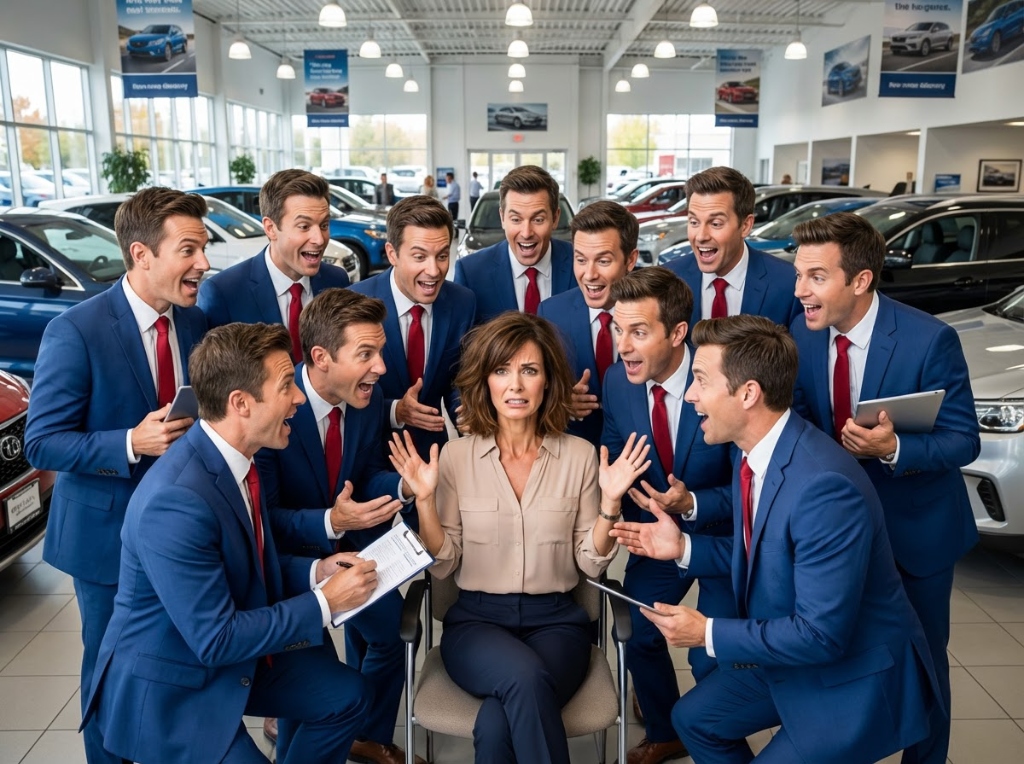
Picture this from a customer's point of view.
It's Saturday morning. They're scrolling Facebook with a cup of coffee. They're in the market for a truck — have been for a few weeks now. And as they scroll they start seeing the ads.
First one: stock photo of a Ram 1500 on a white background. "Find your perfect vehicle today. Visit us online or in store."
Second one: stock photo of a Ram 1500 on a white background. "We have what you're looking for. Shop our inventory now."
Third one: stock photo of a Ram 1500 on a white background. "Get a great deal on the truck you've always wanted."
Different dealerships. Different cities. Same photo. Same headline. Same font. Same everything.
To the dealer, each of those ads represents a unique campaign. To the customer, it's one long, indistinguishable blur of sameness.
And here's the brutal truth — they don't remember any of them.
// HOW THE CLONE ZONE GETS BUILT
It doesn't happen because dealers are lazy. It happens because of how the automotive marketing industry is structured.
A large agency or vendor wins a national contract with a dealer group or OEM. They build a templated ad solution — a system that can be deployed across hundreds of rooftops simultaneously with minimal customization. Logos swap out. Location names change. The inventory feed populates. And suddenly 200 Chrysler Dodge Jeep Ram dealers are running the same ad with different names on it.
From the vendor's perspective this is efficient. Scalable. Profitable.
From the customer's perspective it's noise. Identical, forgettable, interchangeable noise.
The agency gets paid. The dealer gets lost in the crowd. And the customer — the actual human being they're trying to reach — gets hit with the same ad from a dozen different dealerships and can't tell any of them apart.
You're not running a campaign. You're participating in wallpaper.
// WHAT THE CUSTOMER ACTUALLY EXPERIENCES
This is the part most dealers never think about — because they're looking at their own ads in isolation. They see their campaign. Their creative. Their spend. Their results.
They never stop to think about what it feels like to be on the other side of it.
A car buyer in the market right now is being hit with automotive ads constantly. Multiple times a day. Across Facebook, Instagram, YouTube, and now connected TV. And because every dealer is using the same vendor solutions, pulling from the same stock photo libraries, and following the same OEM brand guidelines — the experience is relentless repetition.
Here's what they're actually seeing in their feed:
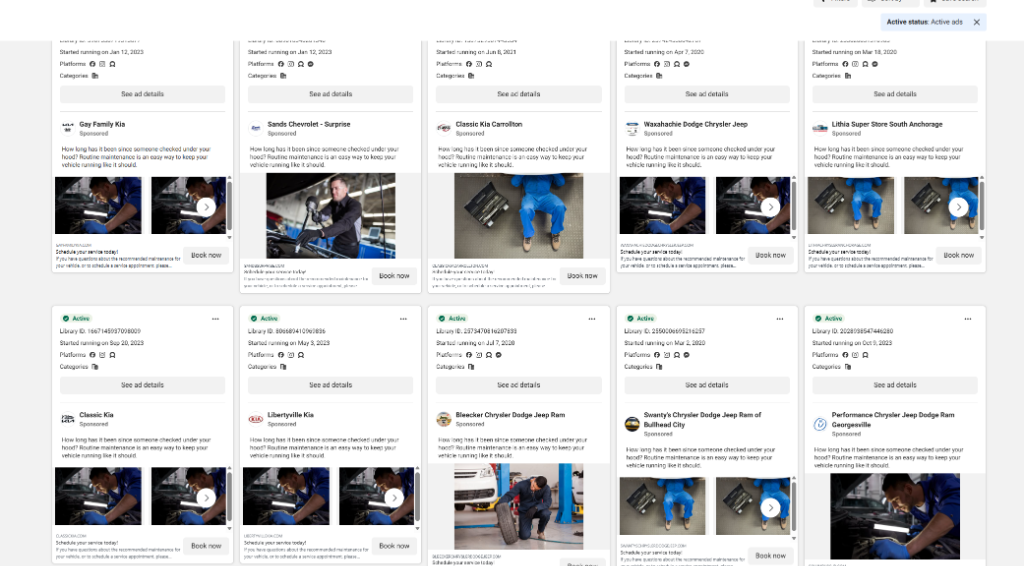
Dealer B: "Wondering what your vehicle might be worth? We've got you covered."
Dealer C: "Wondering what your vehicle might be worth? We've got you covered."
Those three ads are real. Pulled from actual Facebook ad libraries. Three different dealerships. Word for word identical copy. Same stock image. Same "Get Offer" button.
Now multiply that across every dealer in their market. Every brand they've browsed. Every OEM running national campaigns. The customer isn't experiencing marketing. They're experiencing a wall of sameness so thick it becomes invisible.
When everything looks the same, nothing gets seen. And the dealer paying the most for the most forgettable ad in the feed is the one losing the most.
// THE TEMPLATE TRAP
The template isn't just a creative problem. It's a strategic one.
When you buy into a templated ad solution you're not just getting a stock photo and generic copy. You're getting someone else's strategy — built for average results across hundreds of accounts, not breakthrough results for yours. The targeting is broad. The messaging is safe. The creative is vetted for compliance across every possible context, which means it's been sanded down to the least offensive, least interesting, least memorable version of itself.
Safe is the enemy of effective.
The dealers who win in a crowded market aren't the ones who followed the template. They're the ones who made someone feel something in the three seconds before the scroll.
Emotion is the entry point. Always. A buyer who laughs at your ad, or feels seen by it, or is surprised by it — that buyer remembers you. They click. They come back. They show their spouse. They book the appointment.
A buyer who sees your stock photo for the fourteenth time that week keeps scrolling.
// THE DIRTY SECRET BEHIND THE CREATIVE TEAMS
Here's something the automotive marketing industry doesn't talk about openly.
Most of the people writing your ads — the ones responsible for the copy, the strategy, the creative direction — don't have backgrounds in copywriting. Many don't have formal marketing training at all. They're account managers who learned on the job. Coordinators who got promoted. Junior hires who figured out how to use the platform tools.
This isn't an insult. It's just a reality that explains a lot about why the industry looks the way it does.
When you don't have the foundational skills to build something from scratch, you do what anyone does — you look at what's working and you replicate it. One agency runs a campaign that gets traction. Another agency sees it, reverse engineers the copy, and runs something nearly identical for their clients. Before long every agency in the space is running a variation of the same idea. The original is forgotten. The copy of the copy of the copy is now the industry standard.
This is how "Wondering what your vehicle might be worth? We've got you covered" ends up running word for word across three hundred dealerships simultaneously.
Nobody invented that line with intention. Nobody A/B tested it against something bolder. Nobody asked whether it actually makes a buyer feel anything. Someone ran it. It got clicks. Someone else copied it. And now it's everywhere — which means it's nowhere.
The clone zone isn't just a technology problem or a vendor incentive problem. It's a talent problem. An originality problem. An industry that has been copying off each other's papers for so long that nobody remembers what an original idea looks like anymore.
The result: dealers paying premium ad spend to run the same creative as their direct competitors, managed by people who learned their craft by imitating the people they were competing against.
If everyone at the table is copying from the same source, the whole industry fails upward into mediocrity together.
// THE INVENTORY AD ILLUSION
There's a particular flavor of clone zone ad that deserves its own conversation — the inventory ad.
The logic seems sound: show people the actual vehicles you have. Price them. Link directly to the VDP. Let the inventory sell itself.
The problem is that everyone is running inventory ads. Every dealer in a 50-mile radius. Every competing brand. The buyer looking for a truck sees twenty inventory ads before lunch — all showing trucks, all showing prices, all linking to websites that look the same.
Inventory ads commoditize your dealership. They turn the buying decision into a pure price comparison — and in a price comparison, the only winner is the dealer willing to go lowest. That's a race you don't want to run.
You are not an inventory feed. You are a dealership with a culture, a team, and an experience that no stock photo can communicate.
The dealers who break out of the clone zone aren't necessarily the ones with the best inventory or the lowest prices. They're the ones who made the buyer feel something before they ever set foot on the lot.
// WHAT BREAKING OUT ACTUALLY LOOKS LIKE
It doesn't require a massive budget. It doesn't require a Hollywood production crew. It requires a willingness to say something real to the person on the other side of the screen.
Think about what your buyer is actually experiencing right now. Their car is making a noise they can't identify. The check engine light has been on for three weeks. They got judged in the carpool line. They're embarrassed every time they pull away from a stoplight in a cloud of smoke.
That's the story. Not the Ram 1500 on a white background.
A video that shows a mom in the school pickup line, windows down because the AC is broken, kids mortified in the backseat — that stops the scroll. Not because it's slick. Because it's true. Because the person watching it has lived that exact moment and they feel seen in a way that no inventory ad has ever made them feel.
That's the difference between a clone and a campaign. One fills space in a feed. The other starts a conversation.
Your buyer isn't waiting for the best price. They're waiting for someone to speak to them like a human being. The first dealer to do that wins.
// THE REVENANT PHILOSOPHY
We built Revenant on a simple principle that cuts against everything the automotive marketing industry has normalized.
We don't copy. We don't template. We don't run the same playbook across a hundred accounts and call it a strategy.
Every product we build starts with a genuine insight about human behavior — why people buy, what makes them feel, what stops them from scrolling. We combine that with original creative, AI-powered technology, and a relentless focus on one outcome: booked appointments.
And we operate with a philosophy that is baked into everything we do —
Innovate faster than they can copy.
Never be like the rest of them.
By the time the clone zone catches up to what we're doing today, we're already doing something they haven't seen yet. That's not arrogance. That's the only way to stay genuinely useful to the dealers who trust us with their marketing.
Because the moment we start copying is the moment we become the thing we built Revenant to replace.
// THE HARVEST APPROACH
This is exactly the problem Revenant's Harvest product was built to solve.
We don't run inventory ads. We don't use stock photos. We don't pull from a template library that fifty other dealerships are already using.
We build emotion-first campaigns — original AI-produced video creative that speaks to where your specific buyer is in their specific journey. Each campaign is built around a psychological insight: the embarrassment of an aging vehicle, the desire for something that reflects who they actually are today, the quiet relief of finally solving a problem they've been putting off.
When they click, they don't land on a form. They land on a conversation — a voice AI concierge trained on that specific campaign, ready to talk about exactly what brought them there and guide them toward a test drive and appraisal.
No template. No clone. No copy that twelve other dealers are running word for word in the same market.
Just a campaign built for your dealership, speaking to your buyer, in a language that actually earns their attention.
The
clone zone is crowded.
There's a lot of room outside of it.
What are your competitors doing right now?
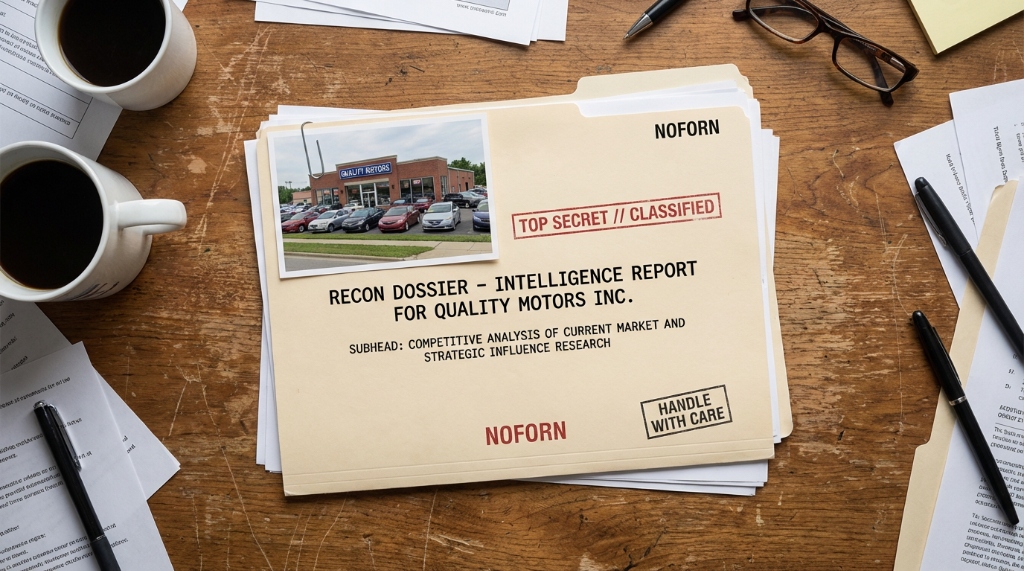
We pull the intelligence on their offers, their reputation, and their ad spend. No guesswork. Just the market, exactly as it is.
Request Your Recon Dossier